
Götaland
One of three lands of Sweden, home of the Geats.

Azurescapegoat · CC BY-SA 4.0
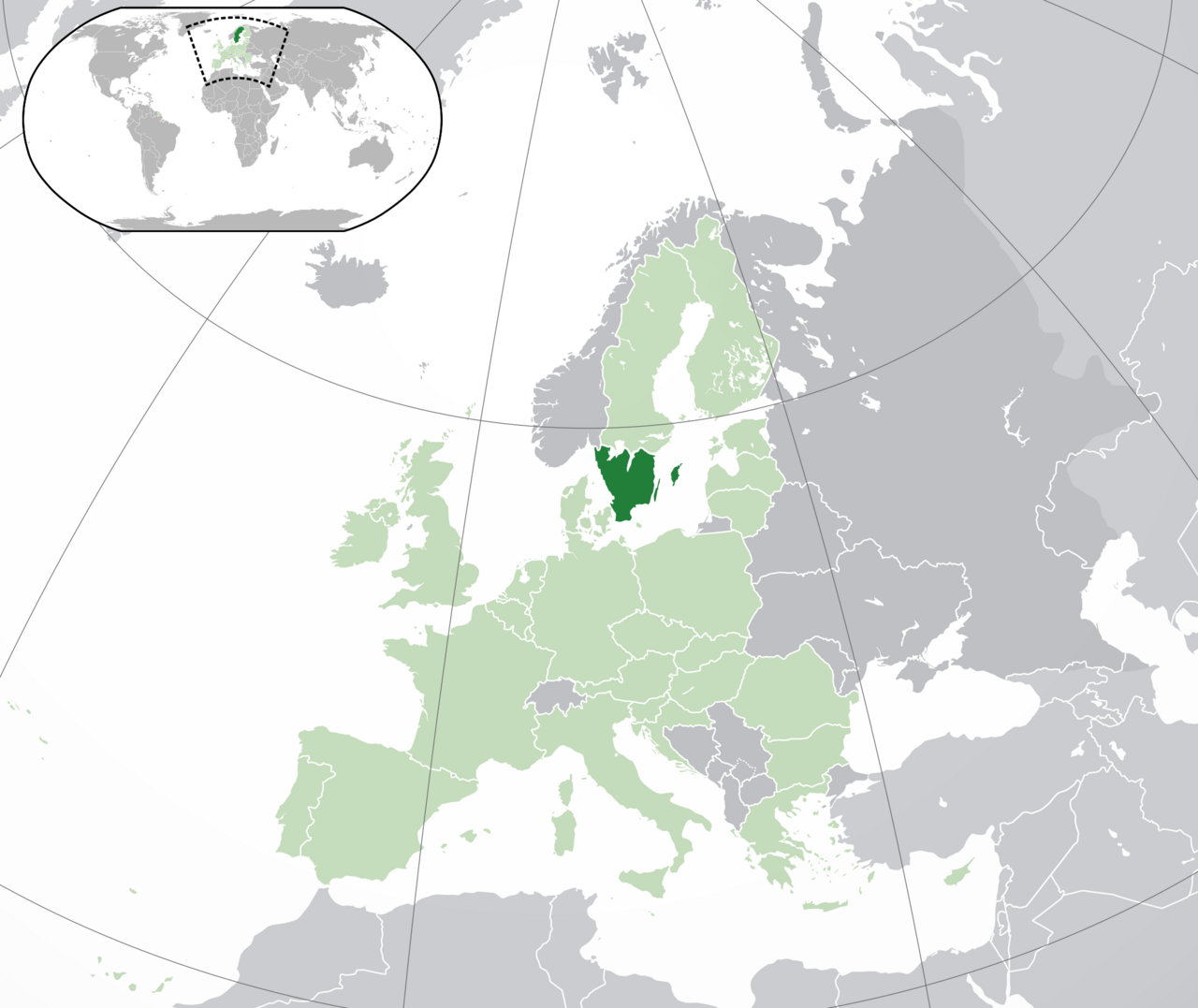
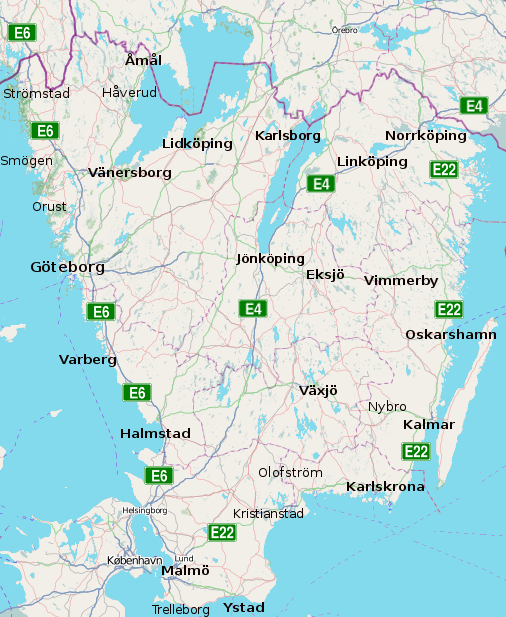
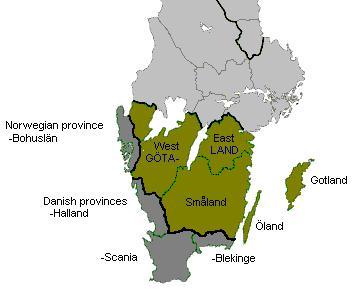
Götaland is one of the three lands of Sweden, located in the south of the country and comprising ten provinces. It was once a collection of petty kingdoms whose inhabitants were called Gautar in Old Norse, a term that mainly referred to the population of modern Västergötland and is agreed to mean the same as Geats, the people of the hero Beowulf in England's national epic. The modern state of Sweden began to form as some provinces of Götaland became politically intertwined with those of Svealand, a process traceable to at least the 10th century.
- Type
- Historical land of Sweden
- Provinces
- Ten
- Geographic location
- Southern Sweden, bounded north by Svealand
- Population
- Approximately 4.4 million
- Notable for
- Home of the Geats (Gautar), the people of Beowulf
- Historical status
- Unofficial entity, no administrative function today
Lore & Background
Götaland once consisted of petty kingdoms whose inhabitants were called Gautar in Old Norse, though Gautar mainly referred to the population of its western part, modern Västergötland. It is agreed that Gautar meant the same as Geats, the people of the hero Beowulf in England's national epic. The earliest possible mention of the götar is by the 2nd-century geographer Ptolemy, who mentions the Goutai. Later, the Anglo-Saxon epic Beowulf (8th–11th century) is partly set among the Gēatas.
Reader's Guide
Götaland's significance lies in its role as the heartland of the Geats, a people central to the Old English epic Beowulf, and as a foundational component of the modern Swedish state. The name Götaland replaced the old Götland in the 15th century, probably to distinguish the wider region from the traditional heartland in Västergötland. It was only late in the Middle Ages that Götaland began to be perceived as a part of Sweden; in Old Norse and Old English sources, Gautland/Geatland is treated as a separate country from Sweden. Today, Götaland has no administrative function but is generally considered one of three Swedish lands, roughly comprising the modern counties of Blekinge, Gotland, Halland, Jönköping, Kalmar, Kronoberg, Östergötland, Scania, and Västra Götaland. Its legacy endures in the cultural and historical identity of southern Sweden.
Did You Know?
- Götaland comprises ten provinces and is one of three lands of Sweden.
- The name Götaland replaced the old Götland in the 15th century.
- The earliest possible mention of the götar is by the 2nd-century geographer Ptolemy, who mentions the Goutai.
The Three-Tier Statistical Framework
The NUTS classification system, standing for Nomenclature of Territorial Units for Statistics, organizes Sweden's territory into three hierarchical levels, all prefixed with the country code SE. At the broadest tier, the nation is divided into three major zones: SE1 covering East Sweden (Östra Sverige), SE2 encompassing South Sweden (Södra Sverige), and SE3 representing North Sweden (Norra Sverige). Each of these first-level regions is further subdivided into second-level units, and those in turn break down into third-level units that align with individual counties. Below this NUTS structure, two additional Local Administrative Unit (LAU) levels exist, providing even finer granularity for statistical reporting. The entire coding scheme is designed to facilitate comparable data collection across European nations, with downloadable code lists available in ODS format for researchers and analysts working with Swedish territorial data.
Regional Groupings and County Composition
Sweden's NUTS framework groups its twenty-one counties into distinct statistical regions. East Sweden (SE1) contains Stockholm County as a standalone unit alongside a cluster of five counties in East Middle Sweden, including Uppsala, Södermanland, Östergötland, Örebro, and Västmanland. South Sweden (SE2) is the most internally complex region, splitting into Småland and the islands (comprising Jönköping, Kronoberg, Kalmar, and Gotland counties), a South Sweden sub-region with Blekinge and Skåne, and a West Sweden grouping of Halland and Västra Götaland. North Sweden (SE3) spans three sub-regions: North Middle Sweden with Värmland, Dalarna, and Gävleborg; Middle Norrland with Västernorrland and Jämtland; and Upper Norrland with Västerbotten and Norrbotten. This arrangement reflects geographic and economic logic rather than purely administrative boundaries.
The Pre-2008 Code System and Riksområden
Under that earlier framework, the country was organized into eight second-level subdivisions known as riksområden (singular: riksområde), a term that translates roughly to national areas. These eight units collectively encompassed all twenty-one Swedish counties. A notable peculiarity of the old system was that only Stockholm (designated SE01) mapped directly onto a single homonymous county, while the remaining seven riksområden each bundled multiple counties together. The transition to the current three-level NUTS structure represented a significant reorganization of how Swedish territory is statistically delineated, moving away from the riksområde model toward a more granular and internationally standardized classification that aligns with EU statistical reporting requirements.
NUTS Levels Versus Traditional Swedish Lands
A critical distinction exists between Sweden's NUTS statistical regions and the country's traditional historical lands. While the two systems share superficial similarities in their geographic groupings, the NUTS level-1 divisions do not correspond directly to the historical Lands of Sweden. This means a statistical region like SE2 (South Sweden) or SE3 (North Sweden) may cut across or combine territories belonging to different traditional lands, and conversely a single historical land might be split across multiple NUTS units. This disconnect is significant for anyone attempting to reconcile modern EU statistical data with historical or cultural geography. The NUTS system was designed for cross-border comparability within the European Union, whereas the traditional lands reflect centuries of local identity and governance. Researchers working with Swedish data must therefore be careful not to conflate these two fundamentally different organizational logics when interpreting regional statistics.
Gallery
More in Other European Regions 1-23
Spotted an error? Know more?
This is a living reference — every entry is fact-audited, and reader corrections feed straight into our audit queue. Suggest an edit · See this site's audit record